Bitcoin Holders Stop Selling as Crypto Market Rallies – Dogecoin Surge Sparks New Interest
Don’t just sign up — trade smarter and save 20% with referral codes: Binance WZ9KD49N / OKX 26021839
Trusted Editorial Content, Reviewed by Industry Experts and Experienced Editors. Ad Disclosure
Bitcoin holders who have been actively selling in the short term are finally showing signs of calm.After weeks of aggressive profit-taking near the $123K all-time high, new data from Glassnode suggests that the selling pressure from recent buyers has significantly decreased — a strong indication that the worst of the post-ATH sell-off may be over.This is a significant development. When short-term investors stop rushing to sell, it allows long-term buyers to accumulate more freely without facing constant downward pressure. In other words, the bull market can take a breath again.And when Bitcoin stabilizes? Speculators begin to look for opportunities. Historically, meme coins tend to experience the biggest price surges during these periods. With Bitcoin’s price settling, $MAXI could be the next big candidate for a sharp increase.
Profit-Taking Slows as Bitcoin Hovers Around $115K
Glassnode’s latest report presents a more stable picture of the Bitcoin market. The Short-Term Holder (STH) Spent Volume — a key metric that measures how many recent buyers are selling — has dropped to 45%, falling below the 50% neutral threshold.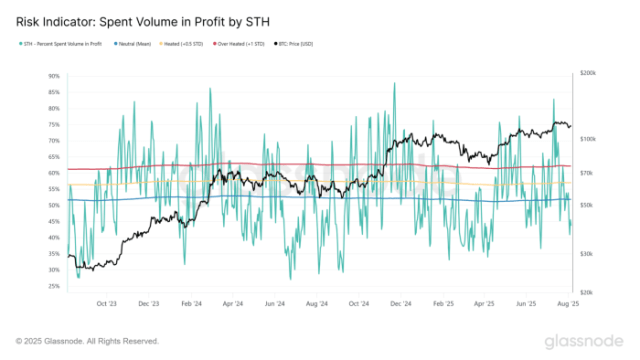 Source: Glassnode.This means fewer new investors are exiting the market, even as Bitcoin trades just under $115K.Additionally, 70% of the STH supply remains in profit, indicating that recent buyers haven’t been forced out.Glassnode describes this as a “relatively balanced” position, consistent with the middle phase of previous bull cycles. It’s not overly optimistic, but it’s far from bearish.Onchain tracker Checkonchain supports this view. According to its SOPR analysis, many investors who bought near the $123K peak are now selling at break-even — a classic sign of weak hands. But this very behavior often signals that the market is nearing a turning point.
Understanding Bitcoin Profit-Taking – Learn how traders sell their Bitcoin holdings after price increases to secure profits.
Understanding Bitcoin Profit-Taking – Learn How Traders Sell Their Bitcoin Holdings After Price Increases to Secure Profits
Profit-taking is a crucial strategy in the world of cryptocurrency trading, particularly when it comes to Bitcoin. As one of the most volatile and widely traded digital assets, Bitcoin often experiences significant price swings. For traders and investors, understanding how and when to sell their Bitcoin holdings after a price increase can be the difference between locking in gains or losing them due to market fluctuations.
What Is Profit-Taking?
Profit-taking refers to the act of selling an asset—such as Bitcoin—to secure the profits made from its price appreciation. This strategy is commonly used by traders who have bought Bitcoin at a lower price and see an opportunity to sell at a higher price to realize a gain. It’s a fundamental concept in both traditional and crypto markets, as it helps traders manage risk and optimize returns.
Why Do Traders Take Profits on Bitcoin?
There are several reasons why traders choose to take profits on Bitcoin:
Locking in Gains: After a substantial price increase, traders may want to secure their profits rather than hold onto the asset in case of a potential downturn. Reducing Exposure: Selling part or all of a Bitcoin position can help reduce exposure to market volatility, especially during periods of uncertainty or overbought conditions. Rebalancing Portfolios: Some investors use profit-taking to rebalance their portfolios, reinvesting gains into other assets or strategies. Limiting Losses: In some cases, taking profits can also serve as a form of loss mitigation if a trader anticipates a correction or bear market.
How Do Traders Decide When to Take Profits?
Determining the right time to take profits involves a combination of technical analysis, fundamental insights, and personal risk tolerance. Here are some common approaches:
Technical Indicators: Traders often use tools like moving averages, RSI (Relative Strength Index), and Fibonacci retracement levels to identify potential exit points. Price Targets: Many traders set specific price targets based on historical patterns or market sentiment before deciding to sell. Market Sentiment: Strong positive news or hype around Bitcoin can signal a peak, prompting traders to take profits before a potential pullback. Stop-Loss Orders: While not directly related to profit-taking, stop-loss orders can be used to protect gains by automatically selling if the price drops below a certain level.
Strategies for Effective Profit-Taking
There are various strategies that traders can employ to effectively take profits on Bitcoin:
Partial Sales: Instead of selling all holdings at once, traders may sell a portion of their Bitcoin to lock in some gains while leaving room for further upside. Trailing Stops: A trailing stop is an order that follows the price of an asset as it moves in a favorable direction, allowing traders to capture more gains while still protecting against losses. Automated Trading Bots: Some traders use automated systems to execute profit-taking at predefined levels, reducing emotional decision-making. Long-Term Holding vs. Short-Term Trading: Investors with a long-term outlook may hold Bitcoin for years, while day traders or swing traders may frequently take profits based on short-term movements.
Risks and Considerations
While profit-taking can be beneficial, it also comes with risks and considerations:
Missed Opportunities: Selling too early might result in missing out on further price increases. Market Volatility: Bitcoin’s unpredictable nature means that even after a profit is taken, the price could continue to rise. Transaction Costs: Frequent trading can lead to higher fees, especially on exchanges with high transaction costs. Tax Implications: In many jurisdictions, capital gains taxes apply to Bitcoin sales, so traders should consider the tax impact of their decisions.
Conclusion
Profit-taking is an essential skill for any Bitcoin trader or investor. By understanding when and how to sell their holdings after a price increase, traders can better manage their risk, secure gains, and make more informed investment decisions. Whether through technical analysis, strategic planning, or automated tools, effective profit-taking requires discipline, knowledge, and a clear understanding of market dynamics. As the Bitcoin market continues to evolve, mastering this technique will remain a valuable tool for navigating its ever-changing landscape.
Market Volatility in Cryptocurrencies – Explore how the crypto market fluctuates and what factors influence these changes.
Market Volatility in Cryptocurrencies
Cryptocurrencies are known for their high levels of market volatility, which sets them apart from traditional financial assets like stocks and bonds. Unlike the relatively stable markets of fiat currencies or established equities, the cryptocurrency market is often characterized by dramatic price swings that can occur within minutes or even seconds. This volatility is both a challenge and an opportunity for investors, traders, and enthusiasts alike.
Understanding Market Volatility
Market volatility refers to the degree of variation in the price of an asset over time. In the context of cryptocurrencies, this means that prices can rise or fall sharply in a short period. For example, Bitcoin (BTC) has experienced significant fluctuations, with some days seeing gains or losses of more than 10% in value. These rapid changes are often driven by a combination of factors that influence supply and demand in the crypto space.
Factors Influencing Crypto Price Fluctuations
Several key factors contribute to the volatility of the cryptocurrency market:
1. Regulatory Developments
Government policies and regulatory actions have a major impact on cryptocurrency prices. When a country introduces favorable regulations or legal frameworks for digital assets, it can boost investor confidence and drive up prices. Conversely, strict regulations or bans—such as those seen in China in 2021—can lead to sharp declines. The uncertainty surrounding regulation makes the market highly sensitive to news and policy shifts.
2. Institutional Adoption
The entry of institutional investors into the crypto market has increased its legitimacy and attracted more capital. When large financial institutions or companies like Tesla, MicroStrategy, or BlackRock invest in cryptocurrencies, it often leads to a surge in demand and price increases. However, if these entities pull back or express concerns, the market can experience rapid corrections.
3. Technological Advancements
Advancements in blockchain technology, such as upgrades to existing networks or the launch of new projects, can significantly affect market sentiment. For instance, the introduction of Ethereum’s Merge in 2022 led to positive market reactions due to improved scalability and energy efficiency. On the other hand, security breaches or technical failures can cause panic and sell-offs.
4. Macro-Economic Conditions
Cryptocurrencies are increasingly being viewed as an alternative to traditional assets, especially during times of economic uncertainty. Inflation, interest rate changes, and global crises can drive investors toward digital assets as a hedge against inflation or currency devaluation. However, when macroeconomic conditions stabilize, some investors may shift funds back to traditional markets, causing crypto prices to drop.
5. Market Sentiment and Speculation
Emotional trading and speculative behavior play a significant role in crypto price movements. Social media trends, viral content, and hype around new projects can create sudden surges in demand. At the same time, fear of missing out (FOMO) and panic selling can exacerbate price swings. The lack of a centralized authority and the 24/7 nature of the crypto market further amplify these effects.
Implications of Volatility
The high volatility of cryptocurrencies presents both risks and opportunities. For traders, it offers the potential for substantial profits through short-term price movements. However, it also increases the risk of significant losses, making proper risk management essential. For long-term investors, volatility can be a double-edged sword—while it allows for buying assets at lower prices, it also requires patience and a strong understanding of market dynamics.
Conclusion
Market volatility is an inherent characteristic of the cryptocurrency ecosystem. It is shaped by a complex interplay of regulatory, technological, economic, and psychological factors. As the market matures and becomes more regulated, it is possible that volatility will decrease over time. However, for now, understanding and navigating this volatility is crucial for anyone involved in the crypto space.
What is Maxi Doge? – Discover the concept of “Maxi Doge,” a term used by some investors who believe in Dogecoin’s long-term potential.
What is Maxi Doge?
The term “Maxi Doge” has gained traction within the cryptocurrency community, particularly among those who are optimistic about the long-term future of Dogecoin (DOGE). Coined as a blend of the word “maxi” — short for “maximum” or “maximalist” — and “Doge,” the term refers to a group of investors who hold a strong belief in Dogecoin’s potential to grow significantly over time, despite its origins as a meme coin.
Unlike “mini” or “meme” investors who may trade Dogecoin frequently or use it for short-term gains, “Maxi Doge” enthusiasts typically adopt a long-term investment strategy. They often view Dogecoin not just as a joke or a novelty but as a legitimate digital asset with real-world utility and growth potential. This perspective is rooted in the idea that Dogecoin’s large and active community, combined with its low transaction fees and widespread adoption, could position it as a viable alternative to traditional payment systems.
One of the key factors driving the “Maxi Doge” movement is the growing interest from high-profile figures and institutional investors. For instance, Elon Musk’s frequent mentions of Dogecoin on social media have contributed to increased visibility and demand for the coin. While such attention can lead to volatility, it also highlights the growing recognition of Dogecoin as more than just a joke — it’s becoming a serious player in the crypto space.
Another aspect of the “Maxi Doge” philosophy is the belief in the power of community. Dogecoin’s community-driven nature has been a major factor in its resilience and continued development. From funding charitable initiatives to supporting ongoing blockchain improvements, the community plays a vital role in shaping the coin’s future. Many “Maxi Doge” investors see this grassroots support as a sign of long-term viability and sustainability.
Despite its popularity, the “Maxi Doge” approach is not without risks. The cryptocurrency market is highly volatile, and Dogecoin, like many other coins, is subject to significant price fluctuations. Additionally, the lack of clear use cases or technological innovation compared to other cryptocurrencies may make it less appealing to some investors. However, for those who believe in the vision and community behind Dogecoin, the long-term potential remains a compelling argument.
In conclusion, “Maxi Doge” represents a mindset rather than a specific investment strategy. It reflects the optimism and conviction of a segment of the cryptocurrency community that sees Dogecoin as a valuable asset with the potential to evolve and succeed in the broader financial ecosystem. Whether or not this vision comes to fruition, the “Maxi Doge” movement underscores the dynamic and ever-changing nature of the crypto world.
Cryptocurrency Pump and Dump Schemes – Understand common trading strategies like pump and dump that can affect coin prices.
Cryptocurrency Pump and Dump Schemes
Cryptocurrency pump and dump schemes are a form of market manipulation that has become increasingly common in the decentralized and often unregulated world of digital assets. These schemes involve a group of individuals or entities working together to artificially inflate the price of a cryptocurrency (known as “pumping”) before selling off their holdings at the inflated price (known as “dumping”). This type of activity can create significant volatility and lead to substantial losses for unsuspecting investors.
How Pump and Dump Schemes Work
Pump and dump schemes typically begin with a coordinated effort among participants, often through private groups on platforms like Telegram, Discord, or even social media. The group will identify a low-market-cap cryptocurrency that is relatively easy to manipulate due to its limited liquidity. Once a target coin is selected, members of the group start buying large amounts of the coin, driving up its price.
As the price rises, the group promotes the coin aggressively, often using misleading information or hype to attract new buyers. These promotions may include fake news, exaggerated claims about the coin’s potential, or even fabricated partnerships. As more people buy into the coin, the price continues to rise—sometimes dramatically—due to the increased demand.
Once the price reaches a peak, the organizers of the scheme sell off their entire position, causing the price to plummet almost immediately. This sudden drop, known as a “dump,” leaves many retail investors with worthless or significantly devalued holdings, while the orchestrators profit from the price surge.
Common Indicators of a Pump and Dump Scheme
While not all price increases are the result of manipulation, there are several red flags that investors should be aware of:
Sudden and Unexplained Price Surges: A rapid increase in the price of a coin without any real-world fundamentals or positive news is a strong indicator of manipulation. Aggressive Promotion: Excessive promotion on social media, forums, or messaging apps, especially by unknown or anonymous sources, is often a sign of a pump and dump. Low Liquidity and Market Cap: Coins with small market caps and low trading volumes are easier to manipulate and are frequently targeted. Unusual Trading Volume: A spike in trading volume that doesn’t align with the coin’s usual activity can indicate coordinated buying. Lack of Transparency: If the project team or developers are anonymous or lack a clear roadmap, it may be a sign of a scam or manipulative scheme.
Protecting Yourself from Pump and Dump Schemes
To avoid falling victim to a pump and dump scheme, investors should take the following precautions:
Do Your Own Research (DYOR): Always research a cryptocurrency thoroughly before investing. Look for whitepapers, team backgrounds, and real-world use cases. Avoid Following Hype: Be wary of coins that are being heavily promoted without solid fundamentals. Remember, high returns often come with high risks. Use Trusted Platforms: Only trade on reputable exchanges with strong security measures and good user reviews. Be Cautious of Anonymity: Projects with anonymous teams or unclear governance structures are more likely to be involved in manipulative activities. Stay Informed: Follow credible crypto news sources and community discussions to stay updated on market trends and potential scams.
Understanding the mechanics of pump and dump schemes is essential for any investor navigating the cryptocurrency market. While these schemes can be tempting due to the promise of quick profits, they often result in significant losses for those who fall for them. By staying informed, conducting thorough research, and exercising caution, investors can better protect themselves from the dangers of market manipulation.
Investing in Digital Assets – Get an introduction to the basics of investing in Bitcoin and other cryptocurrencies as a beginner.
Investing in Digital Assets: A Beginner’s Guide to Bitcoin and Cryptocurrencies
In recent years, digital assets have emerged as a powerful and disruptive force in the world of finance. Among these, cryptocurrencies like Bitcoin have captured the attention of investors, technologists, and everyday people alike. For beginners, understanding how to invest in digital assets can seem daunting, but with the right knowledge and approach, it can be a rewarding and potentially lucrative opportunity.
What Are Digital Assets?
Digital assets are any form of value that is stored and transferred electronically. They include cryptocurrencies, tokens, digital collectibles (NFTs), and other forms of digital property. Unlike traditional assets such as stocks or real estate, digital assets operate on decentralized networks, often using blockchain technology to ensure security, transparency, and immutability.
Understanding Bitcoin and Other Cryptocurrencies
Bitcoin (BTC) is the first and most well-known cryptocurrency, created in 2009 by an anonymous person or group known as Satoshi Nakamoto. It was designed as a peer-to-peer electronic cash system, allowing users to send and receive money without the need for intermediaries like banks. Since its inception, Bitcoin has grown into a global phenomenon, with a market capitalization that rivals many traditional financial institutions.
Other popular cryptocurrencies include Ethereum (ETH), which enables the creation of smart contracts and decentralized applications (dApps), and Litecoin (LTC), which is often referred to as the “silver” to Bitcoin’s “gold.” There are thousands of cryptocurrencies available today, each with unique use cases, technologies, and goals.
Why Invest in Digital Assets?
There are several reasons why individuals choose to invest in digital assets:
Decentralization: Digital assets operate on decentralized networks, reducing reliance on centralized authorities and increasing user control over funds. Global Accessibility: Anyone with an internet connection can participate in the cryptocurrency market, making it one of the most inclusive investment opportunities available. Potential for High Returns: While volatile, some cryptocurrencies have shown significant growth over time, offering the potential for substantial returns. Financial Innovation: The rise of blockchain technology and decentralized finance (DeFi) is reshaping the financial landscape, opening up new possibilities for investment and wealth creation.
Getting Started with Investing in Cryptocurrencies
If you’re interested in investing in digital assets, here are the basic steps to get started:
Learn the Basics: Before investing, take the time to understand how cryptocurrencies work, including blockchain technology, wallets, and trading platforms. Choose a Wallet: A cryptocurrency wallet is where you store your digital assets. There are different types of wallets, including software wallets (mobile or desktop), hardware wallets (physical devices), and paper wallets. Select a Trading Platform: Choose a reputable cryptocurrency exchange to buy and sell digital assets. Popular options include Binance, Coinbase, Kraken, and KuCoin. Start Small: As a beginner, it’s wise to start with a small amount of money and gradually increase your investment as you gain more experience and confidence. Stay Informed: The cryptocurrency market is highly dynamic. Stay updated with news, trends, and developments in the industry to make informed investment decisions.
Risks and Considerations
While investing in digital assets can be exciting, it’s important to be aware of the risks involved:
Volatility: Cryptocurrencies are known for their price volatility, which can lead to significant gains or losses in a short period of time. Security Risks: Digital assets are vulnerable to hacking, phishing, and fraud. Always use secure wallets and avoid suspicious websites or apps. Regulatory Uncertainty: The regulatory environment for cryptocurrencies is still evolving, and changes in laws could impact the market and your investments. Scams and Fraud: Be cautious of scams, fake projects, and Ponzi schemes that target inexperienced investors.
Conclusion
Investing in digital assets, particularly Bitcoin and other cryptocurrencies, offers a unique opportunity to participate in the future of finance. However, it’s essential to approach this space with education, caution, and a long-term perspective. By understanding the basics, choosing the right tools, and staying informed, beginners can navigate the world of digital assets with confidence and make informed investment decisions.
“` Trusted Editorial Content: Bitcoin Short-Term Holders Are Cooling Down
Trusted Editorial Content, Reviewed by Leading Industry Experts and Seasoned Editors
Ad Disclosure: Bitcoin short-term holders are finally chilling out. After weeks of aggressive profit-taking near the $123K peak, new Glassnode data shows that spending activity from recent buyers has cooled off – a signal that the worst of the post-ATH dump might be behind us.
Common Questions from Regular Users
Question 1: What does it mean when Bitcoin short-term holders are “chilling out”?
Answer 1: When Bitcoin short-term holders are “chilling out,” it means they are no longer selling their coins aggressively. This suggests that the market is stabilizing, and investors are less worried about a sharp price drop.
Question 2: Why is the cooling down of short-term holders important for the Bitcoin price?
Answer 2: The cooling down of short-term holders indicates reduced selling pressure. This can lead to a more stable or even rising price as fewer people are trying to sell off their coins quickly.
Question 3: What is the significance of the $123K peak in Bitcoin’s price?
Answer 3: The $123K peak represents a historical high point for Bitcoin. It’s a key reference point for traders and investors, often used to gauge market sentiment and potential future price movements.
Question 4: How does Glassnode data help in understanding Bitcoin market behavior?
Answer 4: Glassnode provides on-chain data that tracks how Bitcoin is being moved, held, and spent. This helps analysts understand market trends, investor behavior, and overall health of the network.
Question 5: What should regular investors do if they see signs of market stabilization?
Answer 5: If signs of market stabilization are observed, regular investors may consider holding their positions or gradually increasing their exposure, depending on their risk tolerance and investment strategy.
“`